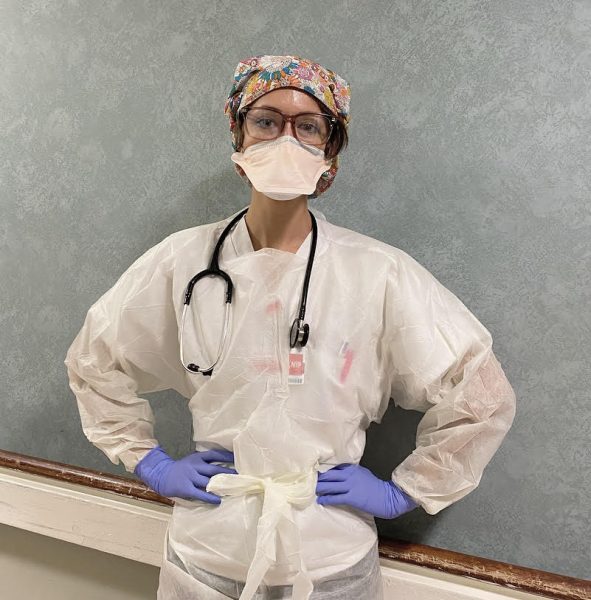
I don't think I realized how lucky I was to get to go to UIndy until I first started working as a nurse, and it finally clicked. Wow, I get to be a nurse. I absolutely love my profession.
The University of Indianapolis MSN Family Nurse Practitioner (MSN-FNP) online track prepares you to elevate your career as a nurse practitioner through a top-tier education, a culture of service and inclusion, and comprehensive student support.
With an MSN in Family Nurse Practitioner (FNP) degree from the University of Indianapolis, you’ll be qualified to practice autonomously* as a primary care provider for patients across the lifespan and make a positive impact on society.
*Scope of practice and need for physician supervision varies by state law.
The MSN-FNP track is 46 credit hours, with 750 clinical hours, and is completed on a part-time basis. It can be completed in 8 consecutive semesters (2 years and 7 months).
This track is online, the non clinical courses are asynchronous and the clinical courses are synchronous. Students will be required to come to campus for periodic checkoffs in their health assessment and diagnostics courses. In compliance with new competency based accreditation requirements, students may also need to come to campus for Observed Structured Clinical Examinations (OSCE) learning experiences during their clinical courses.
UIndy's School of Nursing provides one-on-one advising through these courses:
This course has both didactic and laboratory components. The course prepares the student to conduct comprehensive health assessments of patients throughout the life span. Comprehensive health parameters are applied to the assessment process. Students perform detailed health histories, family histories, physical examinations, and selected screening and prevention/wellness skills. Clinical reasoning development and differentiation between normal and abnormal findings are emphasized. Integrated throughout the course are principles of health promotions/wellness, illness prevention, and early detection.
This class is a diagnostic and procedure-based course that has didactic and laboratory components. The course provides evidence-based knowledge in diagnostics and procedures utilized in primary care to develop a comprehensive treatment/management plan. Students will gain knowledge of the use of clinical data, the interpretation of diagnostic information, the limits of using clinical data for diagnosis, appropriate diagnostic procedures, laboratory tests, using clinical data to problem solve, and follow-up care for patients with both acute and chronic conditions. This course emphasizes psychomotor skills necessary to provide selected common primary care procedures utilized in the care of children and adults throughout the life span in a variety of clinical settings. Students will demonstrate psychomotor skills (procedures) and knowledge gained in this class in a laboratory setting.
This course provides a comprehensive medical and pathophysiologic foundation for the evaluation of clients in various health care settings. Students will analyze the relationship between normal physiology and the disease state. A brief review of normal physiology and anatomy is included, as well as the pathophysiology of selected disorders and diseases. This course is intended to enable advanced practice nurses to understand and bridge the pathophysiological foundations of various disease processes as manifested by signs and symptoms seen in the clinical setting. Students will analyze the relationship between normal physiology and the different disease states. They will develop an understanding of the mechanism(s) underlying different disease syndromes and their clinical manifestations, so that therapeutic rationale can be ascertained. An introduction to appropriate screening and diagnostic laboratory evaluative methods related to advanced primary care nursing practice will also be included. Emphasis will be placed on the clinical understanding and identification of disease states.
There are 2 intakes: Fall and Spring
View the full admissions requirements.
All expenses, including tuition and fees, are subject to change annually.
Students will be required to have technology that is compatible with the required computerized testing platform software. Please see the IT Help Page for requirements needed for Windows and MAC OS computers. Chromebooks will not meet the technology requirements for the School of Nursing.
*A computer that meets ExamSoft/Examplify expectations is required.
I don't think I realized how lucky I was to get to go to UIndy until I first started working as a nurse, and it finally clicked. Wow, I get to be a nurse. I absolutely love my profession.