Community Patient Resource Group (CPRG)
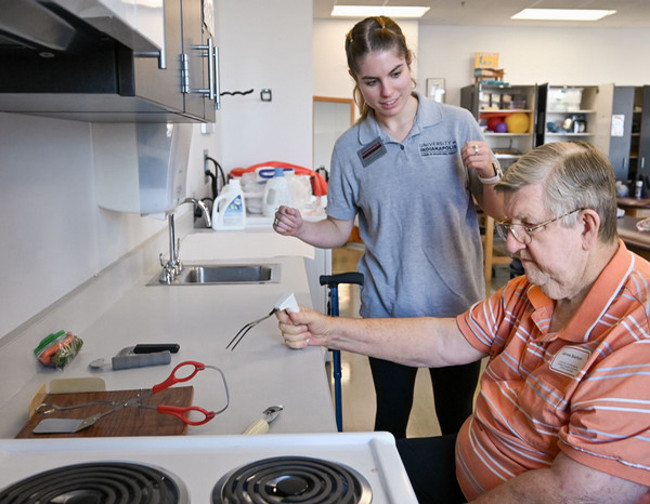
The Community Patient Resource Group (CPRG) consists of community members who volunteer their time to the University of Indianapolis (UIndy) to help PT, OT, and PTA students see and work with individuals with actual impairments that require rehabilitation. These volunteers who have had, or currently have, a medical or rehabilitation condition allow the students to see, feel, and better understand the impairments, activity limitations, and participation restrictions that are discussed in the classroom. Our students work with CPRG members during all phases of their education – often as early as the third week of classes!
Diagnostic Categories
Adult members of our CPRG are living with a wide variety of diagnoses, including:
- Amyotropic Lateral Sclerosis (ALS)
- Stroke
- Guillan-Barre Syndrome
- Huntington's Disease
- Multiple Sclerosis
- Parkinson Disease
- Post-polio Syndrome
- Spinal Cord Injury
- Traumatic Brain Injury
- Amputation
- Cardiovascular diagnoses
- Other diagnoses including arthritis, joint replacement, back problems, and balance issues
Our pediatric volunteers are living with diagnoses including:
- Down Syndrome
- Spina Bifida
- Cerebral Palsy
- Autism Spectrum Disorder
Benefits to students
- Students can expect to work with CPRG members beginning their first semester, where they learn to complete a subjective history exam and practice skills such as examining an individual's joint range of motion, muscle strength, flexibility, sensation, balance and movement.
- During the second semester, students build on their knowledge and skills by developing an intervention plan for CPRG members based on their exam findings.
- Students also learn to address the health and wellness needs of our CPRG volunteers in a Health Promotions class.
- At the end of Year 1, students complete an Objective Structured Clinical Examination (OSCE), which is a practical examination requiring students to individually perform a full exam and initial intervention on a CPRG member.
- During the second year of the program, students continue to build on their examination and intervention skills in their clinical courses by working with CPRG members across the lifespan who have the specific diagnoses being discussed in the classroom.
- In the neuromuscular course series, students will have hands-on lab practice with adult volunteers who have had a stroke, brain injury, Parkinson disease, multiple sclerosis, or spinal cord injury.
- Students in the neuromuscular courses may also work with pediatric volunteers with Down syndrome, cerebral palsy, or autism spectrum disorder, among others.
- In the integumentary course, students will learn about residual limb care and specific prosthetic training by working with CPRG members who have lower limb amputations.
During the third year of the DPT program, students expand on their intervention skills by working with CPRG members with neuromuscular conditions through interventions such as high intensity variable gait training, submaximal exercise testing, advanced wheelchair skills, and Parkinson's disease-specific exercise programs.
Supporting Evidence
In a 2012 article published in the Journal of Physical Therapy Education, Stephanie Kelly, PT, PhD, Dean of the UIndy College of Health Sciences, and Heidi King, DPT, reported that PT students and faculty perceive this program contributes to the development of student professional values, performance of examination skills, determination of appropriate outcome measures and the integration of health promotion and wellness principles. We greatly appreciate the service of our CPRG members and are proud of how this program contributes to the education of our students.
Interested in being a part of CPRG?
UIndy Krannert School of Physical Therapy faculty typically invite patients from their clinical practices to participate in CPRG, knowing which individuals will provide the maximum learning experience for our students. Participation in the CPRG is strictly on a volunteer basis. Activities performed as a part of the CPRG are not considered "therapy" and individuals with ongoing therapy needs are encouraged to see a physical and occupational therapist. Volunteers must be able to provide their own transportation and be comfortable working within small and large groups. For more information, contact Lashe Hill at hilllr@uindy.edu or call 317-788-3563.